
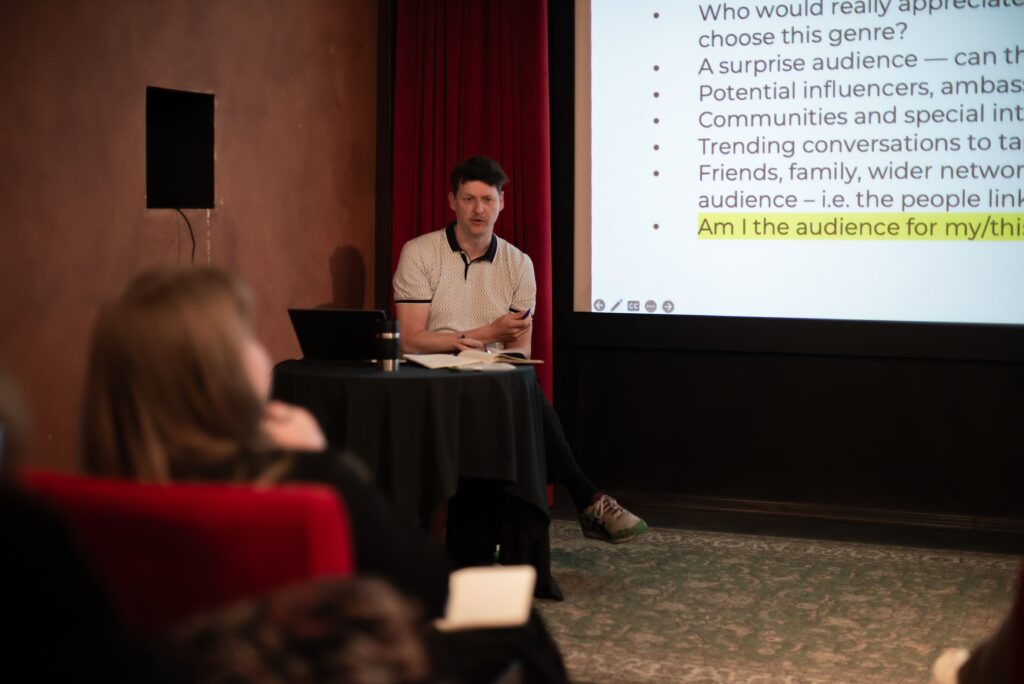
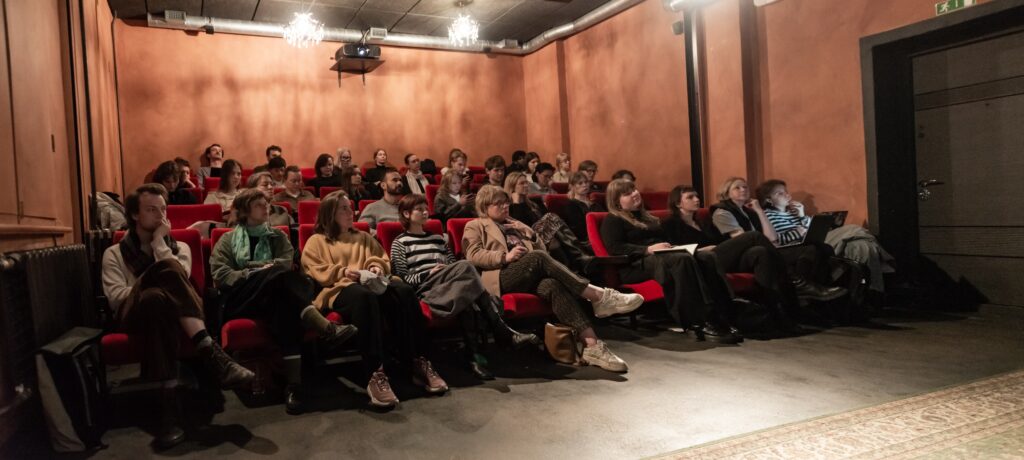
Kino Bize on Elizabetes Street in Riga is home to RPFF’s industry programme. RPFF opened this year with Agnès Varda’s „Daguerréotypes“ — a film about the shopkeepers on her own street in Paris made simply by paying attention to the people already around her. It’s a quiet way to open a festival built around a theme like „Emotional and Sensorial Wandering,“ and I kept thinking about it for the rest of my time in Riga — mostly because it’s the opposite of how most of us are taught to think about audience. I was there for a 90-minute industry session „Who Is Your Film For? Audience Design as a Creative Strategy,“ held in the small screening room at Kino Bize. Free entrance supported by the National Film Centre of Latvia and Creative Europe MEDIA. The kind of session where the room is filled with filmmakers who are still shaping a project and are keen to learn which mistakes producers make.
Where I’d Start, If I Were You
Here’s something I keep coming back to, in one form or another, at almost every one of these sessions — and honestly, I still have to remind myself of it too: most teams end up designing their audience strategy backwards. Touchpoints get picked first — a festival premiere, a VOD window, maybe a social campaign closer to release — and only then does anyone start asking who’s actually going to show up. By that point the film is locked, and „audience“ turns into a marketing problem instead of a creative one.
In the framework I use with filmmakers, touchpoints are step four of six — after Vision, Project Analysis, and Audience itself. I put Vision first for a reason, though I won’t pretend I always get the order right myself: before you can say who a film is for, you have to be honest about what it actually needs to do in the world, beyond simply existing as a finished film.
One example seemed to resonate in the room, so I’ll share it here too: „a film for everyone who cares about climate change“ isn’t really an audience. It’s more of a mood. An actual audience is specific enough that you could say where these people already spend their time online, what they’ve watched before this, who they’d trust to recommend something to them. That level of specificity makes a lot of filmmakers uncomfortable — it can feel like shrinking the film’s ambition. In my experience, it’s usually the opposite. Knowing who you’re talking to is often what lets a film say anything clearly at all.
Good company
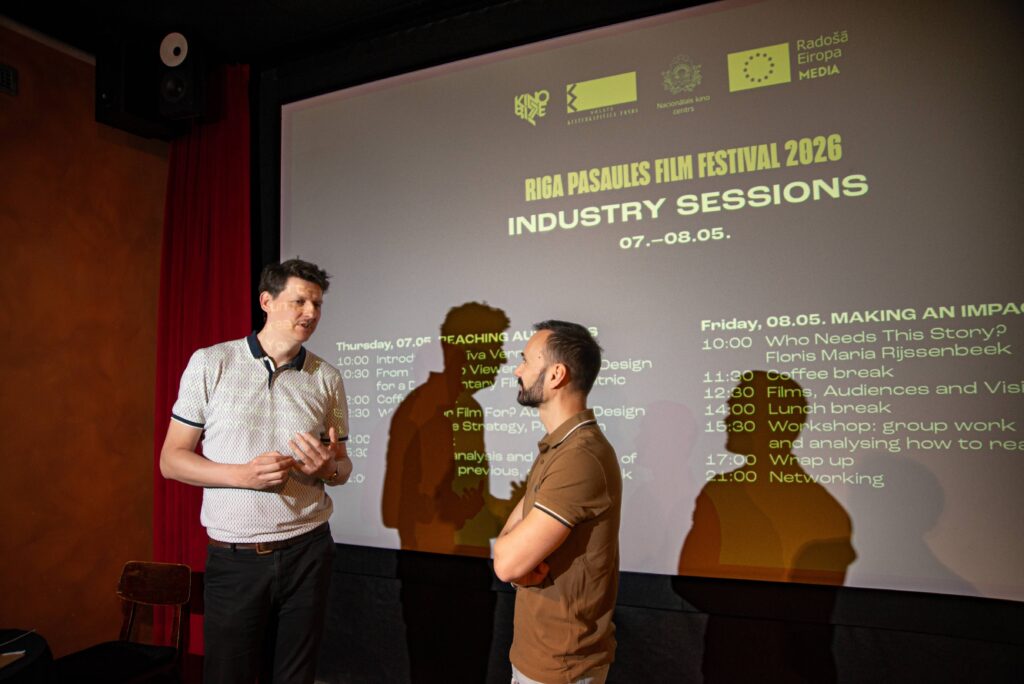
What I liked about Riga this year: I wasn’t the only one circling this question. Petar Mitrić, who teaches film studies in Copenhagen, gave a session on „spect-acting“ — his term for the moment a viewer stops just watching and starts actively reflecting. Floris Maria Rijssenbeek, an impact producer from Brussels, flipped the question entirely: not who will watch this film, but who needs this story. And Cíntia Gil — who programmes for Cannes‘ Directors‘ Fortnight — pushed it even further out: what does „audience“ even mean at all, at a moment with more films being made than ever and a shrinking number of places for them to actually be seen. Four sessions, four different doors into the same room. That felt less like coincidence and more like where the conversation in this industry is actually heading.
Conclusion
If you weren’t in Riga — here’s the one thing I’d want you to take with you: you don’t go looking for your audience out there in the world, hoping to stumble on it. You define it. On purpose, on paper, while the film is still being made — not after. And no, that’s not the same as narrowing what the film is about, whatever your gut is telling you right now. It’s the opposite. It means being honest, early, brutally specific, about who this film is actually for, and what you’d need to know about them to reach them at all. Skip that step, and it doesn’t matter how good the film is — you’ll be shouting into a room with no one in it.
If that’s a question you’re sitting with right now on a project — write to me, I mean that literally, not as a sign-off. And if you’d rather just get more of these thoughts as I have them, the newsletter is the better format for that than this blog, which I update far less often than I’d like.